
It’s a crisp sunny Saturday morning as our crew prepares the car for the drive from Jerusalem to Haifa to cover an antiwar rally. Spirits are high as I place my camera equipment in the boot of the car. Then we discuss footwear.
Stefanie, our correspondent, has chosen to wear comfortable white trainers, expecting the likelihood of violence to be low. However, Luke, whom we’ve hired to provide security, and I have plumped for sturdy boots in case things get heated.
Recommended Stories
list of 4 items- list 1 of 4Palestinians mourn teenager killed by Israeli troops in occupied West Bank
- list 2 of 4Weather becomes weapon in Israel’s genocidal war on Gaza
- list 3 of 4Israel denies entry to Canadian MPs trying to reach occupied West Bank
- list 4 of 4Israeli leaders condemned for politicising Bondi massacre
This is the first antiwar protest to take place in Israel since it began its war on Gaza following the Hamas attacks of October 7.
Since, it hasn’t been easy for the antiwar voice to make itself heard. The organisers of this rally, Hadash, a left-wing socialist party that supports a two-state solution, were initially banned from gathering and had to take their request to the Supreme Court.
The authorities were likely keen to let the protest go ahead on a Saturday when there’s no public transport, which would make it more difficult for people to reach the square.
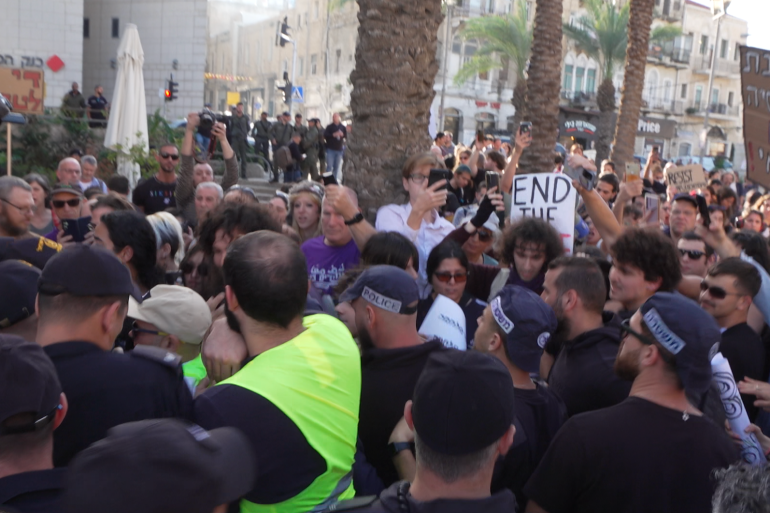
As we make our way to the square, we pass a large contingent of police in blue uniforms as well as what looks like border guards in dark green. They seem to be having a last-minute pep talk before the protest.
No doubt they have concerns as to what might be about to happen. They are armed with rifles and pistols, and they have utility vehicles, the notorious “skunk water truck” and officers on horseback.
I’m starting to feel vindicated by my choice of footwear.
A local photographer explains to me that the police are not happy the protest is going ahead, that the antiwar message is not one they are ready to hear.
“They’re going to provoke violence from the demonstrators to prove that it shouldn’t have gone ahead,” he warns me solemnly.
Our guard is now up. We start to survey the arriving protesters for signs of trouble or possible counter-protesters that may have been planted to try and whip up confrontations.
Luke spots a man reaching into his inner jacket pocket in a very suspicious manner. The man glances around and pulls out … a packet of cigarettes. False alarm, but you can’t be too careful.
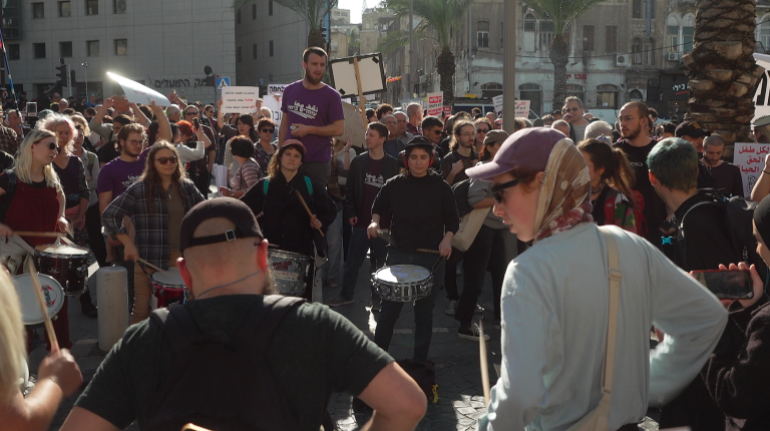
More people start to show up – about 500, many of them young – and some aren’t wearing shoes. I can’t help but feel that the police may have overestimated the danger posed by this particular group of protesters.
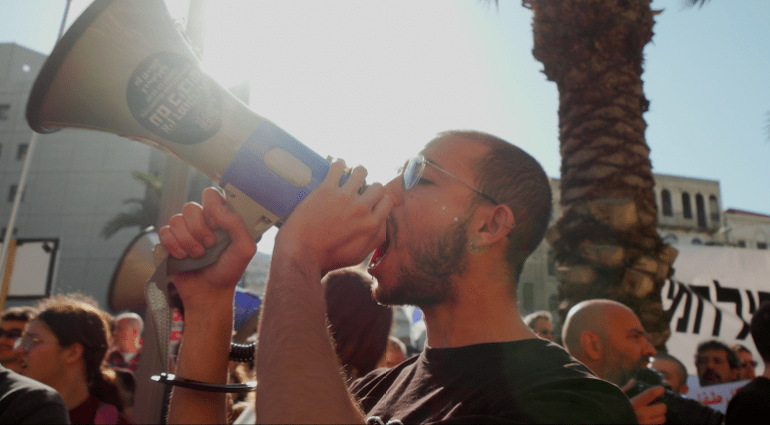
They’re banging drums, shouting slogans through loudspeakers and giving speeches on the importance of reconciliation and the failure of war to bring lasting security.
One of the speakers, Maoz Inon, whose parents were killed by Hamas fighters during Hamas’s attacks on October 7, speaks of forgiveness: “My father cultivated the land. He grew wheat and he also brought me up to believe in a good future.
“My message to the world is don’t choose a side, Israeli or Palestine, but please choose humanity.”

Meanwhile, police are becoming increasingly twitchy. They swoop in on the crowd and pluck a man from it, then lead him away to a nearby vehicle as the protesters, police and press surge back and forth in the confusion.
Fortunately, the situation doesn’t escalate and things soon calm down.
But there are other events. At one point, while I’m filming Stefanie talking to the camera, a Palestinian-Israeli man and his teenage daughter approach us. He apologises for interrupting us before telling us he’d been shoved in the back by a police officer while watching the rally. He’s upset and frustrated, and feels targeted for simply showing up at the rally.
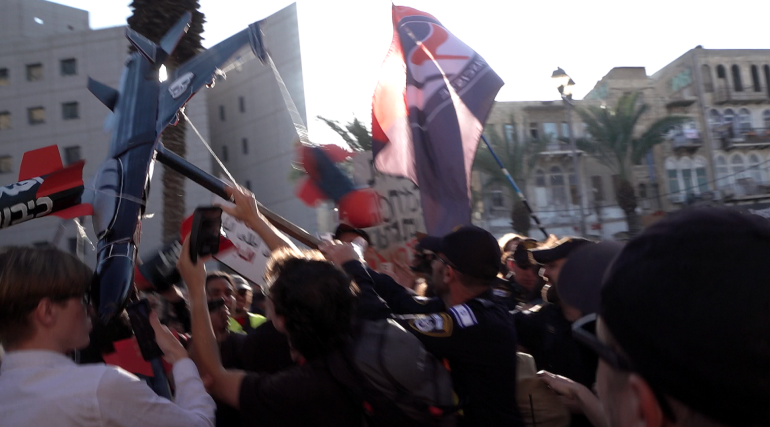
Near the end of the protest, the police make another move. This time, the source of their ire is a paper mâché fighter plane with cardboard bombs dangling beneath. It’s a brief battle before the model plane is snatched away.
Despite the plane incident, the protesters remain upbeat.
When the rally finishes and people begin to file off in different directions, Stefanie stays a little longer to talk with Maoz. Meanwhile, a counter-protester films him and then tries to start arguments with the people that remain.
For now, those protesting here today are in the minority. According to recent polls, the majority of Israelis still support the war in Gaza.